Community Engagement Approaches to Improve Health: An Analysis of Barriers and Facilitators in UK Practice (Angela Harden)

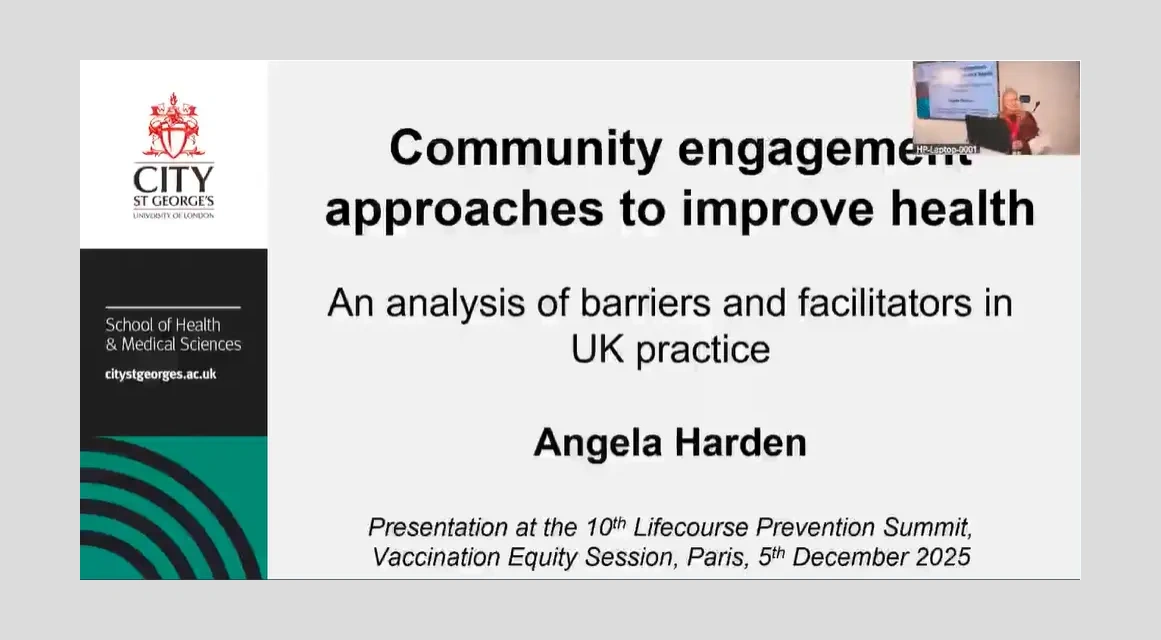
The presentation was delivered and recorded during the 10th Lifecourse Prevention Summit, Paris, December 2025.
In this briefing, Prof. Angela Harden, Professor of Health Sciences at City, University of London, draws on almost three decades of applied health research to present what the evidence says about community engagement approaches to reducing health inequalities and the conditions that need to be in place for them to work.
Community engagement is not a single method but a spectrum,ranging from consultation at one end to full community control at the other.The evidence is clear that approaches across this spectrum can be effective inimproving health and reducing inequalities, but the quality of engagement matters enormously. Consultations that do not genuinely listen produce outcomes that communities did not ask for, a pattern that erodes trust and makes future engagement harder. The danger of tokenism, of going through the motions of involving communities without genuinely sharing decision-making, runs through much of the discussion.
Drawing on evidence reviews and national standards work, she identifies four overlapping pillars of effective community engagement: establishing trust, attending to equity and inclusion, realizing community capacity and assets, and sharing power. These are not sequential steps or a hierarchy but overlapping conditions, where progress on one can support progress on another.
Trust requires time, years rather than weeks, and is best built through organizations and leaders that communities already know. Equity and inclusion mean actively seeking out seldom-heard voices rather than waiting for people to come to meetings, and removing practical barriers through interpreters, childcare, expenses, and welcoming spaces. Asset-based approaches start from what communities already have rather than what they lack, and mapping those assets across individuals, communities, and systems often sparks connections across professional boundaries that would not otherwise happen. Sharing power requires genuine commitment from decision-makers, not just advisory groups that no one attends, and structured but flexible processes that give communities real ownership over outcomes.
A recurring theme is the tension between what good community engagement requires and what short-term project funding allows. Building the relationships and trust that underpin effective engagement takes years, yet funding cycles rarely reflect that reality. Investment in these approaches, sustained and proportionate to need, is a prerequisite for the kind of change that lasts.
.webp)