Addressing Health Inequalities in RSV: Lessons from Barnardo's Public Health Campaign (Rukshana Kapasi)

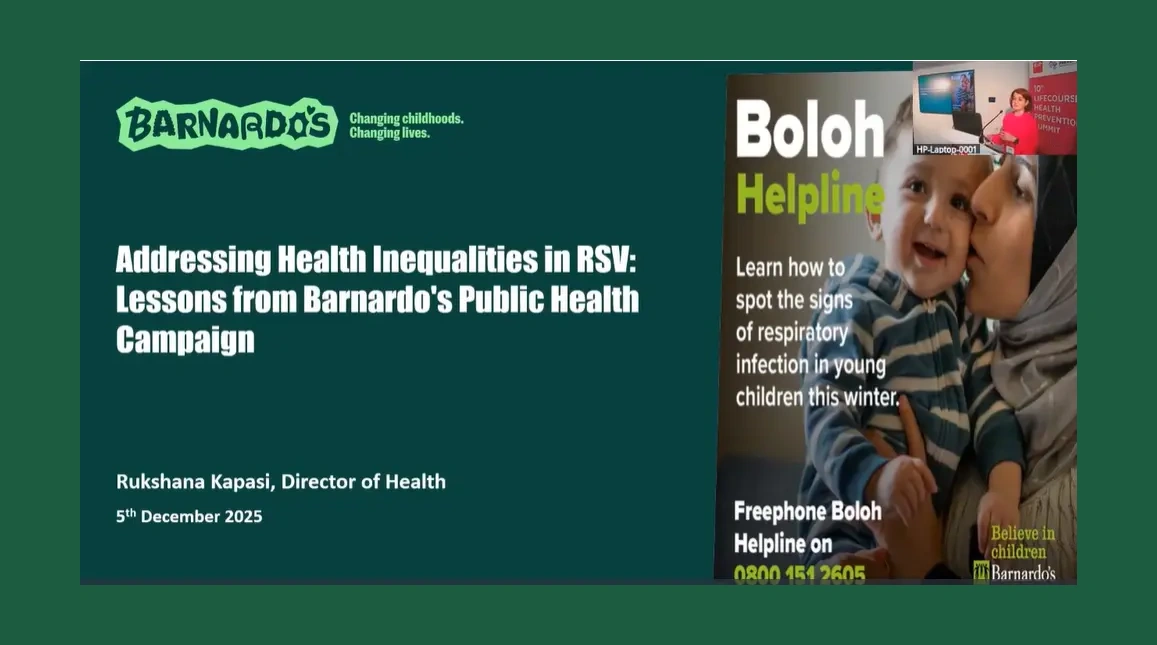
The presentation was delivered and recorded during the 10th Lifecourse Prevention Summit, Paris, December 2025.
Barnardo's Director of Health, Ms Rukshana Kapasi, presents the findings of a six-month NHS England-funded public health campaign run in 2021 to address an anticipated surge in RSV among children under three years old. The campaign was designed to reduce pressure on NHS services by supporting parents and carers in managing pediatric respiratory infections at home, with a particular focus on reaching minority ethnic communities where health information gaps and structural inequalities are most acute.
Kapasi opens with a striking picture of where disparities stand today. RSV vaccine uptake among older adults in the UK sits at 62%, but drops to 21% among Asian Pakistani communities. Maternal RSV vaccine coverage is around 60% overall, falling to 26% among Black Caribbean women, a group already four times more likely to experience maternal mortality. These figures frame the urgency of what Barnardo's set out to do.
The campaign's approach was built on three principles: cultural competence, anti-racism, and integration of health and social care. Rather than adapting existing NHS materials, Barnardo's co-produced resources with communities directly, working through a network of around 100 grass roots organizations and running focus groups with 184 people from different backgrounds. The BOLO helpline, staffed by advisors speaking 14 languages and trained by respiratory nurses, became a central tool, alongside a website, targeted social media, community radio, and outreach through places of worship, babybanks, and refugee support services.
What the evaluation revealed was telling: 50% of those who contacted the helpline needed support that went beyond health advice, coveringfood vouchers, housing concerns, and help navigating the NHS. The health andsocial needs of families, it turned out, could not be addressed in isolation.
Website reach exceeded expectations, stakeholder satisfaction scored 4.25 out of 5, and evidence pointed to sustained behavior change among families reached. The campaign produced a replicable, culturally competent engagement model that Barnardo's makes available for others to adapt.
.webp)