Addressing Social Inequities in Child Health and Vaccine Uptake: Evidence from the UK (David Taylor-Robinson)

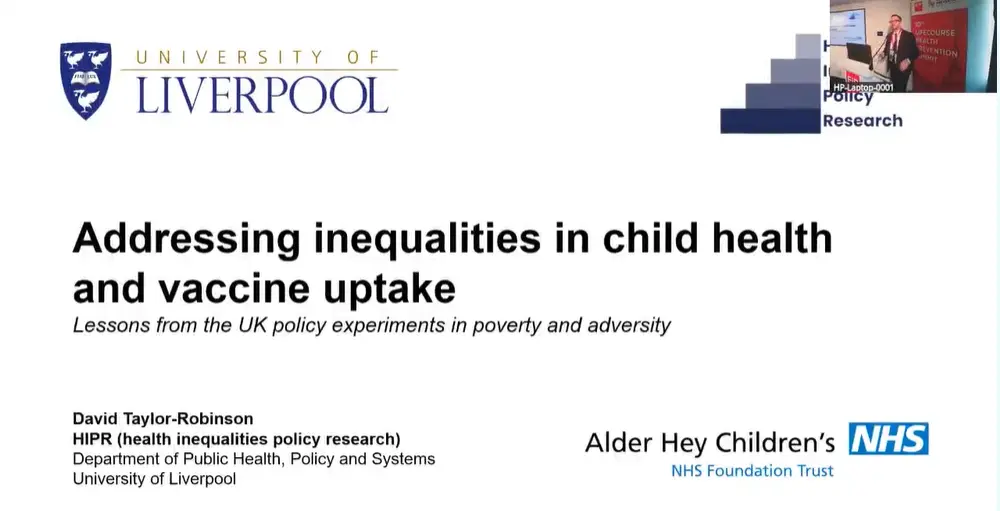
The presentation was delivered and recorded during the 10th Lifecourse Prevention Summit, Paris, December 2025.
The UK ranks 27th in the UNICEF league table for children's health, 27th for child poverty, and 28th for vaccination coverage. For Prof. David Taylor-Robinson, Professor of Public Health and Policy at the University of Liverpool, that alignment is not a coincidence. This briefing presents rigorous epidemiological evidence linking declining vaccination rates in England directly to rising child poverty and austerity-driven cuts to preventative services.
Drawing on a dataset of over one million children, research published demonstrates a clear and widening social gradient in vaccination uptake across all primary childhood vaccines. At every step down the social hierarchy, vaccination coverage drops, and in the most deprived areas of citieslike Liverpool, measles vaccination rates have fallen to levels that, according to Taylor-Robinson, are simply not credible for a high-income country. The consequences are already visible: outbreaks of measles and whooping cough, with children dying from preventable diseases.
The analysis goes further, establishing a causal relationship between rising child poverty and falling MMR coverage. A 1% risein child poverty is associated with a 0.4 percentage-point drop in MMR uptake, suggesting that poverty may account for around a third of the decline in MMR coverage in England over the study period. Cuts to early years services, including SureStart, show a similar causal effect.
Vaccine confidence, by contrast, remains relatively high. Parents still trust vaccines, trust doctors, and trust the NHS. The problem is not attitudes; it is a system that has been progressively defunded and is no longer reaching the children who need it most.
The policy prescription is clear: reduce child poverty, invest in services proportionate to need, and adopt an equity-focused approach to resource allocation. Addressing vaccination inequalities without addressing their root causes, is not a viable strategy.

.webp)