Moral Economies of Trust: Navigating Vaccination in Marginalized and Religious Communities (Ben Kasstan-Dabush)

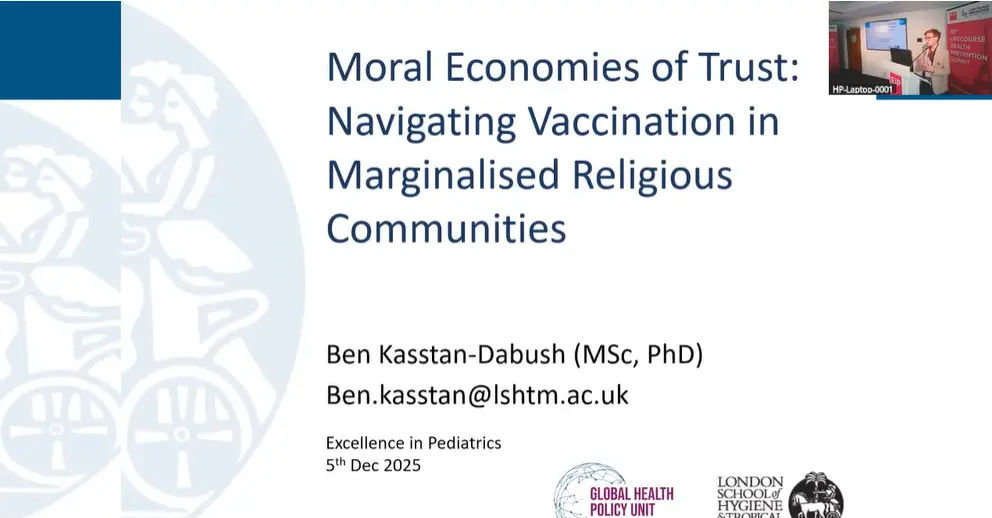
The presentation was delivered and recorded during the 10th Lifecourse Prevention Summit, Paris, December 2025.
Religion is frequently cited as a driver of vaccine hesitancy but rarely examined with any precision. Dr. Ben Kasstan-Dabush, Lecturer in Global Health Policy at the University of Edinburgh and Assistant Professor at the London School of Hygiene & Tropical Medicine, brings a medical anthropologist's lens to this question, unpacking what the evidence actually shows and where public health programs have gone wrong in their assumptions.
In this briefing, he introduces the concept of the moral economy of trust: the norms, values, and obligations that shape how communities engage with vaccination. That economy is fragile, and it is damaged not only by misinformation but by the design of programs themselves. From the polio vaccine boycott in northern Nigeria to coercive COVID-19 vaccination enforcement in Uganda, the briefing traces how top-down approaches and enforcement-driven strategies have eroded rather than built trust in some of the world's most marginalized communities.
Research with ultra-Orthodox Jewish communities in London challenges several common assumptions. Religious authorities are not always the primary influence on vaccine decisions; social networks, gender dynamics, and peer conversations within communities often carry more weight. More importantly, parents in these communities do have questions about vaccination and actively seek guidance, but often cannot find trusted sources.
The consequences of misreading these communities are visible in practice. Vaccine information materials designed with the intention of being culturally sensitive have inadvertently excluded the HPV vaccine from Orthodox Jewish outreach, based on paternalistic assumptions about sexual behavior that parents themselves reject. Healthcare providers, however well-intentioned, can reproduce the very inequities they are trying to address.
What works is sustained collaboration: community navigators, co-produced materials, faith-based health networks, and shared responsibility between public health agencies and community organizations. What undermines it is the short-term, project-by-project funding model that characterizes public health in England, making it nearly impossible to maintain the relationships on which trust depends.
.webp)